
Get Ready for Your Microsoft Copilot Rollout: Strategy, Data, and People
We help you think strategically about your Microsoft Copilot rollout so you can invest in the tools that will unlock the most value.

Throughout the year, it’s good practice to monitor the progress of your strategic initiatives. These evaluation points present invaluable opportunities to gauge how well your initiatives are launching and performing and whether they remain aligned with your overall strategy.
Strategic imperatives set the broad direction and priorities for the organization, while strategic initiatives represent the actionable projects and activities designed to address and fulfill those imperatives. Strategic initiatives are the execution mechanisms to realize the strategic imperatives and move the organization closer to its long-term vision. After some discussion of strategic initiatives and how to launch them, this blog shares seven helpful tips for strategic initiative success.
Before diving into strategic initiatives, it’s important to understand what a strategic initiative is and what it is not. Strategic initiatives, whether in the form of projects, programs or targeted actions, represent the actionable steps that bring a business’s vision to life. They are the tangible manifestations of each strategic imperative, carefully designed to align with the overall strategy and lead the organization toward its long-term goals.
Unlike high-level strategic imperatives, strategic initiatives delve into the details. They outline the specific actions required to accomplish strategic imperatives, leaving no room for ambiguity. Time-bound and equipped with well-defined goals and deliverables, these initiatives provide a clear roadmap for progress. Their significance lies in their ability to execute each strategic imperative by:
Together, these characteristics highlight what separates effective strategic initiatives from well-intentioned activity. They help connect organizational strategy, a clearly defined outcome, and ownership at the right level of leadership. Effective strategic initiatives are not vague improvement efforts. They are deliberate, prioritized actions designed to close the gap between where the organization is today and where it needs to be. They are scoped realistically, resourced appropriately, and measured against meaningful organizational outcomes rather than activity alone.
This matters because strategic initiatives are the primary mechanism through which strategy is executed. Without effective initiatives, even the most well-crafted strategy remains theoretical. Strategic initiatives translate visions into action, ensuring that time, funding and talent are focused on the work that moves the organization forward rather than spread across disconnected projects.
Poorly formed initiatives can impede an organization’s progress and hinder the achievement of strategic objectives. To avoid this challenge, organizations must invest time and effort in developing well-defined, well-aligned and actionable strategic initiatives that support their overall vision and strategy.
Without aligning strategic initiatives with strategic imperatives and overall strategy, you risk wasting resources and efforts on projects that do not contribute to the business’s desired goals.
The question then becomes: How do organizations form initiatives that are built to succeed?
Articulating your company’s strategic initiatives and execution approach is the first step to enabling your teams to understand what’s changing and why, synchronize their approach, and drive toward successful outcomes.
Start by designing initiatives with execution in mind from the beginning by establishing clear accountability, measurable outcomes, and disciplined follow-through. Practical steps include:
Many strategic initiatives fail because their creators overlook execution details or don’t establish clear ownership. Without defined metrics, accountability, and ongoing visibility, even well-intentioned initiatives can stall. Managing initiatives with structure and discipline helps ensure that strategic plans translate into sustained momentum and measurable results.
To put these principles into action, we have seven tips for you to consider. You can customize which you’ll prioritize, but each tip builds on each other to move toward success.
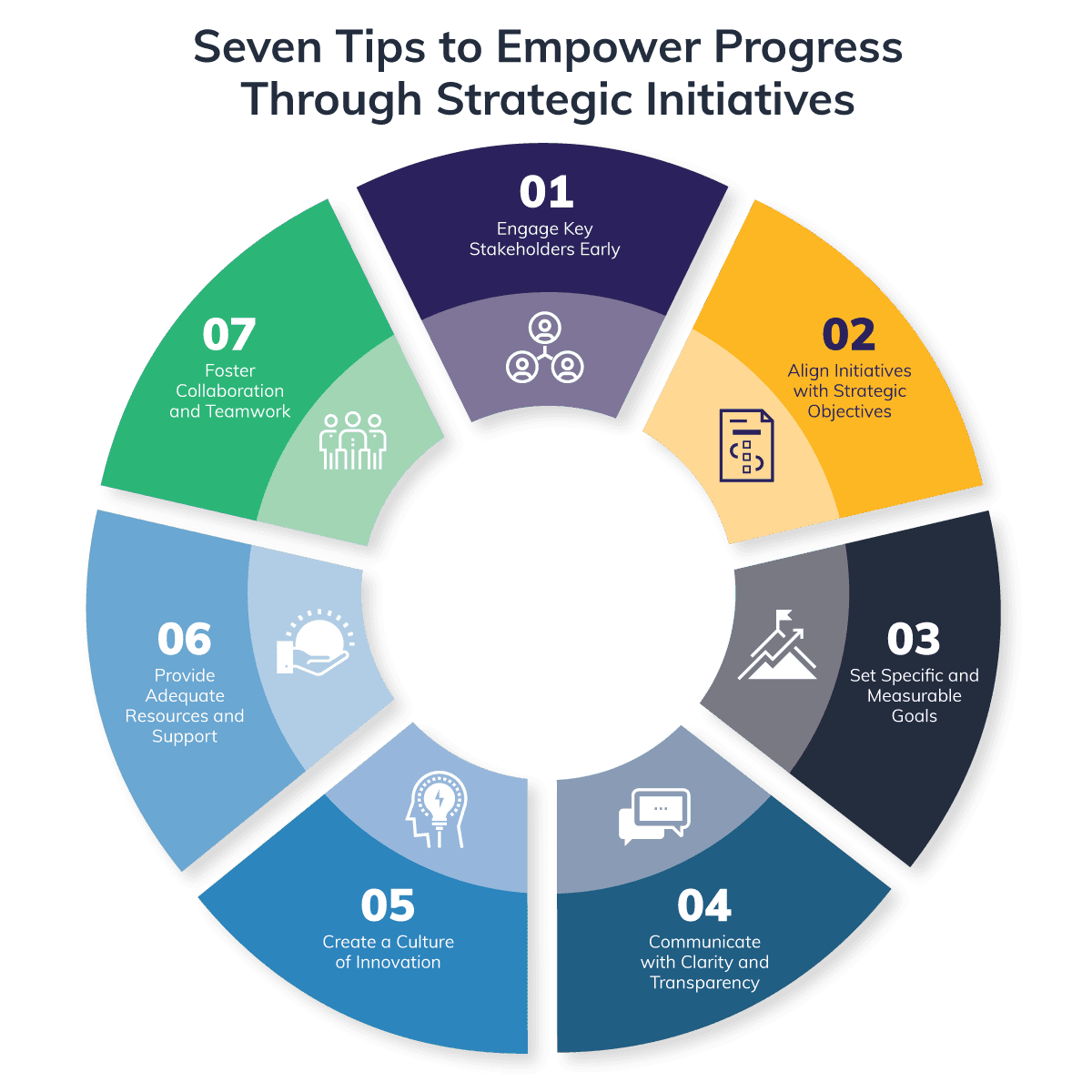
Involve key stakeholders, including leaders, department heads, and project teams, from the outset of strategic initiative formation. By seeking their input and collaboration, you can foster a sense of ownership and commitment, leading to stronger buy-in from those responsible for execution.
Alignment doesn’t happen just at kickoff – it must be maintained throughout execution. Ensure that each strategic initiative directly supports your organization’s strategic imperatives. Clearly articulate how the initiatives will sustain the vision and provide a roadmap for success. Aligning initiatives with strategic goals strengthens their purpose and relevancy.
Strategic initiatives stay aligned with broader business goals through intentional governance, ongoing review and disciplined prioritization. Alignment begins by clearly linking each initiative to one or more enterprise objectives and validating that connection throughout the initiative’s lifecycle. Regular portfolio reviews help leaders assess whether initiatives still support current priorities as business conditions evolve.
Misaligned initiatives exhaust resources without delivering strategic value. Even well-run projects can fail at the enterprise level if they do not advance the organization’s most important goals. Continuous alignment ensures that initiatives remain relevant, that trade-offs are made transparently, and that leadership can confidently invest in the work that delivers the greatest impact.
Establish well-defined, specific and measurable goals for each initiative. Achievable targets make it easier for teams to understand their responsibilities and monitor progress. When teams see the impact of their efforts, motivation and commitment rise.
Use digital tools and dashboards to regularly communicate your initiatives with clarity and transparency throughout your organization. Share updates, successes and challenges to keep stakeholders informed and engaged. Open communication fosters a culture of trust and empowers teams to contribute to the initiative’s success.
Encourage a culture of innovation where new ideas and feedback are welcomed. Provide channels for teams, including your project management office (PMO) and digital collaboration platforms, to share suggestions and improvements related to initiatives. Valuing diverse perspectives, whether on-site or remote, nurtures a sense of ownership and inspires creativity.
Ensure your initiatives receive the necessary resources, including budget, talent and technology. Work closely with the PMO. Address resource constraints proactively to enable teams to carry out their responsibilities effectively.
Promote cross-functional collaboration and teamwork, leveraging both in-person and virtual interactions, to facilitate the seamless execution of your initiatives. Break down silos and encourage interdepartmental communication to optimize overall project outcomes.
Teams can lose momentum during long, complex initiatives when they feel disconnected from the outcome or when progress feels uncertain, especially if company culture begins to erode under pressure.
PMO leaders can keep teams motivated by fostering trust, reinforcing purpose, and actively supporting a strong company culture that values transparency, collaboration and shared accountability. This includes setting clear expectations, communicating regularly about what has been accomplished, and explaining how each phase of work contributes to the overall initiative.
When teams understand where they are in the process, why their work matters, and how it aligns with the organization’s values, they are more likely to stay engaged, focused, and committed to seeing the initiative through.
Organizations and PMOs can also improve initiative success rates by establishing clear governance, prioritization and execution frameworks that connect strategy to delivery, often through enterprise program management. Creating standardized intake and evaluation processes, assigning executive sponsorship, and managing initiatives as part of an integrated portfolio all support those objectives.
When organizations and PMOs evaluate initiatives consistently and align them with enterprise goals, project leaders reduce duplication, manage capacity more effectively, and focus resources on the work that delivers the greatest value.
To avoid common pitfalls such as initiative overload, unclear ownership and competing priorities, PMOs play a critical role in providing visibility, coordination and decision support. They help leaders make informed tradeoffs, track progress across initiatives, and adjust priorities as business needs change, helping to ensure that strategic initiatives remain focused, achievable and positioned for long-term success.
Strategic initiatives are a bridge between strategic imperatives and day-to-day execution, turning long-term goals into focused action that evolves as business priorities change. However, forming and gaining buy-in for strategic initiatives is a continuous journey that requires dedication and persistence.
By engaging stakeholders, aligning initiatives with strategic objectives, setting clear goals, engaging with your PMO and fostering a culture of innovation and collaboration, you can enhance your strategic planning process and propel progress toward your business’s organizational vision. Try tying your initiatives to business cases within your portfolio planning process to get everyone on the same page.
Together, these tips empower your organization to chart a path of success, turning strategic intent into tangible outcomes and making a lasting impact in their industries.
Embrace the power of strategic initiatives and watch your organization thrive as it unlocks its full potential, achieves its vision, and makes a lasting mark in the competitive landscape. You can embark on a path of success, fueled by the collective determination to transform visions into reality.
Ready to build strategic initiatives that are designed to succeed from the start? Our Enterprise Portfolio and Program Management experts can help your organization close the gap between strategy and execution. Let’s Talk