
Executives’ Top 14 ChatGPT FAQs: An AI-Curated Resource
Overwhelmed by questions about ChatGPT? So were we. So, we asked ChatGPT to help us sort it out and pulled the results into this FAQ.

P&C insurance VPs of application development, enterprise architects, and CIOs at P&C carriers who already accept that their legacy technology backlog is problematic but must convince a skeptical CFO — and the rest of the leadership team — to fund the work without a board-level transformation mandate.
The gap between legacy system maintenance and modernization is where most upgrade requests end. The work and the risk are real, but the request still loses to a claims-automation project or a cybersecurity spend with a cleaner story.
However, legacy system rewrites rarely stall or fail based on the merits of your case. Instead, it’s because requests to modernize legacy apps are presented as a high cost with a vague benefit attached, and the soft P&C market has made CFOs ruthless about exactly that.
You already know the continuity, security, staffing risk, and agility drag that come with legacy technology — what’s changed is the cost to fix it.
A rewrite that once meant a years-long, multimillion-dollar program can now run as a contained project within a single budget cycle without pulling the rest of the business off its priorities. This post argues that business risk isn’t what it used to be, and it provides the framework to fix the problem. We’ll cover:
Finally, we discuss how to handle the objections you’ll hear along the way.
Today, the insurance market is softening. The 2025 SwissRe Institute US Property & Casualty outlook forecasted that P&C premium growth would decelerate to about 4 percent in 2026, down from 5.5 percent in 2025, with expanded capacity creating competitive pressure.
That forecast is proving accurate in 2026 premium numbers. The Council of Insurance Agents & Brokers’ Q2 2026 Market Reports stated that average commercial premiums fell 2 percent in the second quarter of 2026. The previous quarter’s fall of 1.2 percent ended a 33-quarter streak of increases — the first overall decline since 2017.
When rates no longer cover the work, efficiency must step in.
At first glance, today’s market looks like the worst time to ask for modernization money, but it’s actually the perfect time. When premium growth slows and margins compress, cost discipline becomes a board-level priority — and a credible plan to cut operating cost now moves to the front of the queue.
The challenge becomes reframing modernization as cost control, not expense. In a hard market, a modernization request competes with growth bets and usually loses. In a soft market, anything that durably lowers the cost of running the business is exactly what the CFO is hunting for. Your legacy technology backlog is one of the largest unexamined cost lines you have.
Position the timing as the CFO already sees it: In today’s market, the cheapest growth available is the money you stop spending. That shifts the conversation from a tech argument to a margin argument, and it’s the one your CFO is already making to the board.
So, the market is on your side. The next step is turning that tailwind into three numbers.
A CFO funds a payback period, not an idea. Give them one. The model that wins approval includes three parts: what you spend today maintaining the estate, the cost to modernize it, and the capacity that’s ultimately freed up. Each part yields a hard number.
None of the figures below are news to you; what’s changed is which one moves. The “R” of ROI — the return on paying down legacy cost and risk — has revealed the same weaknesses for 20 years: aging systems, thinning support, and growing exposure. The investment required to act on cost and risk to improve return is the delta. With this model, that’s the shift now placed in front of your CFO.
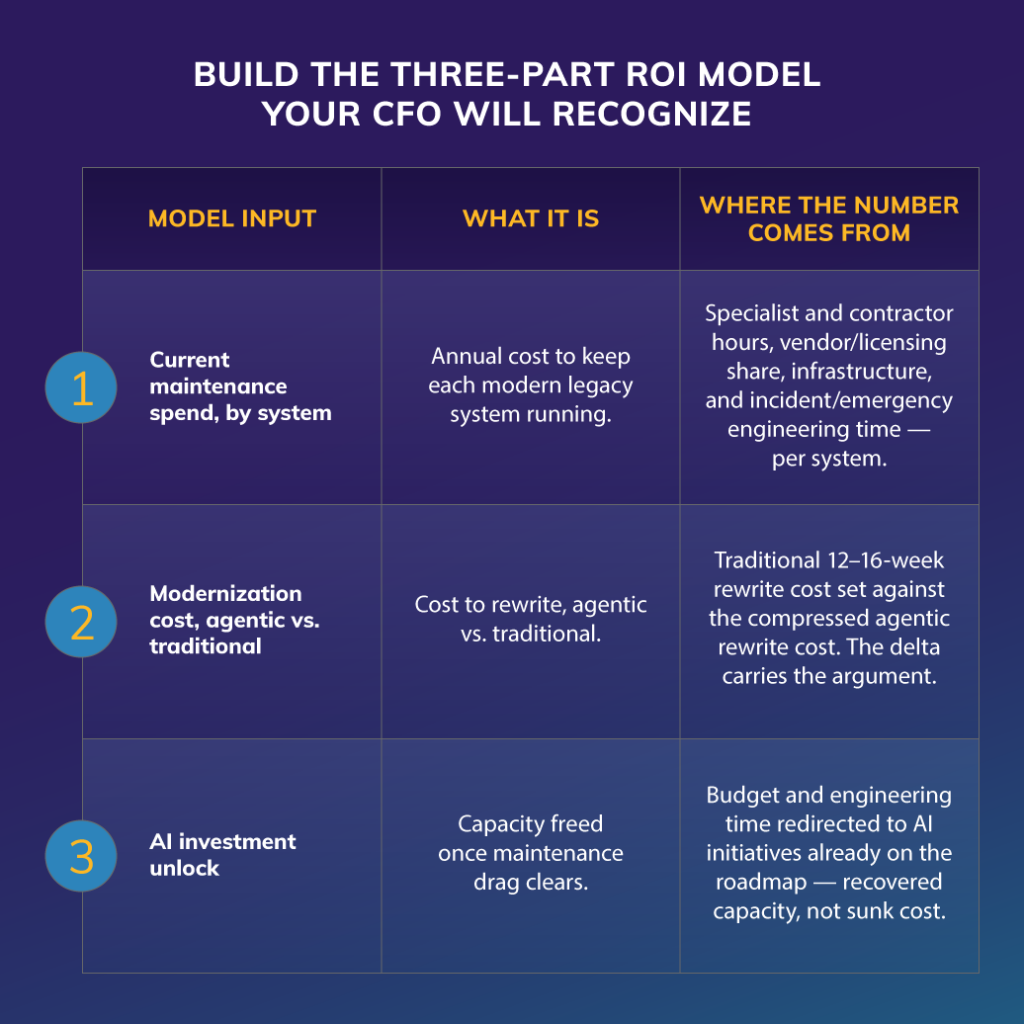
A CFO-ready ROI model has three parts: current maintenance spend, the agentic-vs-traditional modernization cost delta, and the AI investment capacity it unlocks.
Let’s take a closer look at each part:
Part 1: The current maintenance spend by system: Most carriers bear this cost invisibly, spread across contractor hours, specialist salaries, and unplanned incident work. Document it system by system. The industry backdrop makes the scale credible. When you show a CFO that three named systems consume a specific, recurring run rate of six or seven figures with no roadmap value, you shift the conversation.
Part 2: The modernization cost, agentic vs. traditional: This is where the case once fell apart. A traditional rewrite of a midsize legacy application runs 12 to 18 months of skilled engineering time, and the high price tag is what got these systems deprioritized in the first place. An agentic rewrite significantly compresses that work and lowers the cost, which we discuss in the next section. The point for the model is simple: Show both numbers side by side and let the delta carry the argument.
Part 3: Capacity freed for strategic work: This is the part CFOs find most persuasive because it reframes the spend as recovered capacity rather than sunk cost. Every dollar and engineer freed from maintaining a dead-end system becomes available for the initiatives already sitting on your roadmap, including AI.
When you place the three parts in a single table, the request turns from technical plea to financial proposal. A CFO will fund a model that shows recovered cost and a defined payback far sooner than they’ll fund “reducing technical debt.”
However, those three numbers are just one side of the ledger. On the other side is risk, which is harder to quantify but no less real.
You’re already carrying risk that’s challenging to measure. It’s the retirement of the people who understand your systems. It’s the rising costs from vendors. It’s the platforms underneath the systems that age out of support.
None of this risk is new, but the cost and disruption of doing something about it certainly is. This risk now compounds daily.
As we’ll see, the good news is that you don’t need to quantify these risks because of how much agents are changing the math. Instead, simply document them in your modernization case:
As you name each risk, attach a scenario to the two or three that carry the most exposure. That allows the decision to reflect the full cost of the status quo, not just the part that’s easy to calculate.
If your legacy application backlog rewrite never got funded, it’s because the traditional rewrite costs more than the system seemed worth. Agentic modernization changes that ratio — and a changed ratio is what flips a “no” to a “yes.”
But cost is just half of it. The disruption and risk of doing the work have dropped, too, which is why modernizing must no longer compete for a spot in your top strategic priorities to receive funding.
That matters beyond the CFO’s desk. A multi-year transformation needs buy-in from the entire leadership team, and everyone at that table is defending their own priority for the same budget. A contained, application-level project usually skips that fight. It can run inside IT’s discretionary budget without going to committee, which is exactly the kind of decision that doesn’t get delayed or voted down.
Here’s how it works: Expert architects direct a set of specialized AI agents through the rewrite, asking that they mine old code for requirements, surface undocumented logic and dependencies, generate and test new code, and introduce production-ready applications with high automated test coverage.
Human experts handle judgment, prioritization, and validation while agents take on the exhaustive, repeatable engineering work at a scale and speed that manual teams can’t match. That’s a shift from the traditional rewrite, where SMEs and QA teams spent months writing test cases and validating manually. Here, they’re mainly checking outputs, not producing them. Our blog, “Vetting Agentic App Modernization,” covers that workflow in depth.
When it comes to the CFO conversation, what matters most is cost. When the delivered cost drops by 50 to 70 percent, the payback period on a single legacy system shrinks from “never going to clear the bar” to “clears the bar this year.”
A smaller price tag changes the diligence bar, too. Justifying a costly enterprise core-system replacement means putting a precise number on every hard-to-price risk, like security exposure, downtime, and lost agility. Justifying a modernization effort a fraction of that size doesn’t need the same rigor.
Another risk argument is embedded here, too. In many of these systems, the code is the only documentation that still exists. Agents that are mining requirements can surface the hidden dependencies and integration risks before a line of new code is written. This is what prevents the surprise overruns that historically wrecked modernization budgets. CFOs respond to avoided costs.
That predictability is also what separates an application-level approach from the transformation programs your CFO already distrusts.
We saw this play out with one P&C carrier that had more than 360 integrations running on one of the market’s more expensive software as a service (SaaS) integration platforms. We moved them swiftly onto a modern, far more cost-effective platform, using agents to accelerate development and testing rather than the full agentic lifecycle.
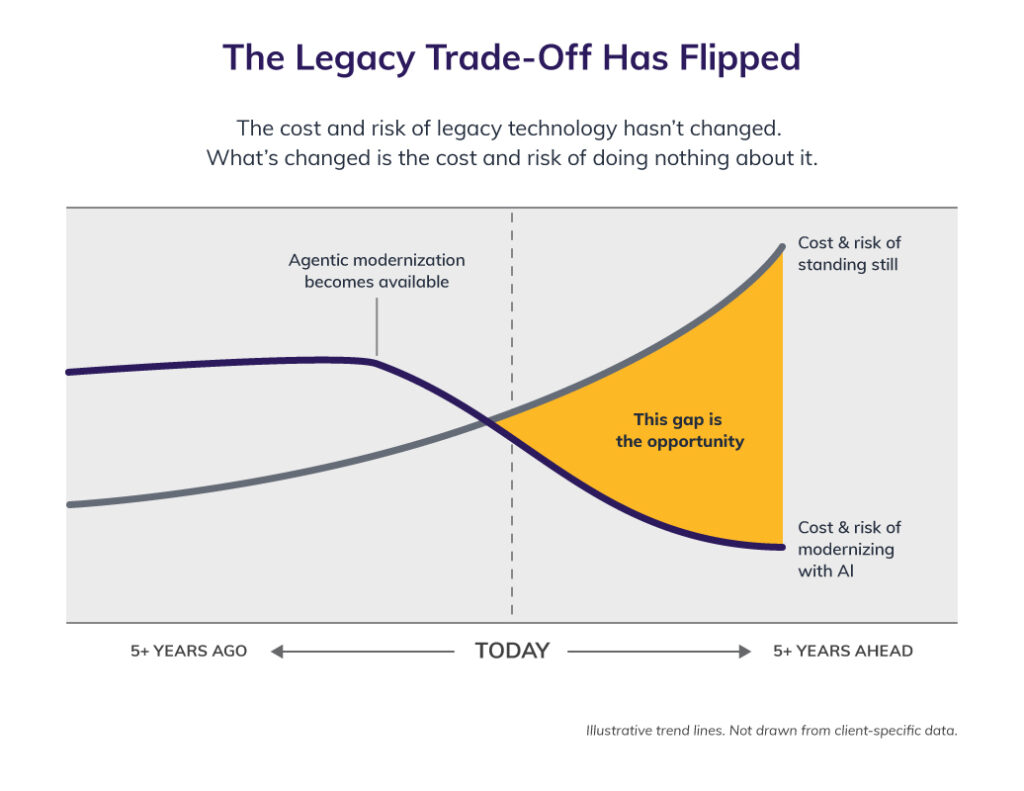
The trade-off has flipped: standing still is now the riskier, costlier path. The gap between the two lines is the window agentic modernization has opened.
The fastest way to lose the leadership team is to make a modernization request sound like a multi-year transformation. They’ve seen those budgets balloon. The strength of the legacy modernization case is that it’s the opposite: incremental, application-by-application, and executable without a board mandate.
That’s a different category of work from core system modernization. Replacing a policy administration system is a year-long, business-critical program with enterprise risk. Clearing a backlog of legacy applications is a sequence of contained projects, each with its own ROI (and its own “go” or “no-go” decision). You can start with one system, prove the model, and reinvest the savings into the next. Most of those individual projects close within a single budget cycle, not the multi-year window a core system replacement requires.
Plus, you don’t have to choose between paying down the backlog and moving the business forward. This work runs alongside your growth priorities, not instead of them. Your underwriting and claims teams stay focused on what grows the business while modernization happens in parallel.
This is a pattern we see across the industry. A carrier rolls out a new policy system, often Guidewire, and wants it in production quickly. Rather than untangle the mainframe underneath, they wire in the new system while still running the mainframe for financial bookings and reporting. “We’ll retire it later,” they say.
The new system ships and the business is happy. But the agility that project leaders promised employees never quite arrives, because every change on the front end now needs a matching change on the mainframe to keep the data flowing.
Plus, “retire it later” rarely happens: The business moves on to the next competitive priority, the people who understand the mainframe retire, and the system that was supposed to go away outlives its retirement date by years.
That’s not a failure of the new platform. It’s what happens when there’s no funded, standalone path to finish the job, which is exactly the gap a contained, application-level project closes.
This distinction matters for AI more than most carriers realize. Increasingly, the barrier to AI in insurance is the data and integration mess underneath the AI, not the models.
The same picture shows up in the broader research: HFS Research and Sutherland found that 74 percent of insurers acknowledge that legacy systems hinder business growth. Clearing the application-level blockers is how the AI investments you’ve already made begin producing.
Pitch it as compound progress, not transformation — one system, proven savings, reinvested into the next. That’s a story a CFO can fund without flinching because every step pays for the one after it.
The case for clearing your legacy technology backlog was always sound. The risk was never the hard part to explain; every CIO already lives with it. What was missing was a way to put the cost of fixing it in the CFO’s language.
When you stop arguing about technical debt and start showing recovered maintenance cost, a defined payback, and capacity for the initiatives that matter, the request stops competing as a cost and starts competing as a return. Because that request no longer costs, or disrupts, what it once did, the need to win moves from “urgent” to “obvious.”
Today’s soft market is the moment for which this argument was made. Cost discipline is already the board’s priority. The cheapest efficiency available to most carriers is sitting in systems they’re paying to avoid replacing.
The carriers that move first will spend the next cycle running leaner and shipping AI while their competitors still fund code maintenance that nobody can read. The numbers are already on your side. Now, the work is putting them in front of the person who signs.