
Consulting Magazine Names Danielle Maldonado a Diversity Champion in 2026 Women Leaders in Consulting Awards
Centric’s Danielle Maldonado named a Diversity Champion in Consulting Magazine’s 2026 Women Leaders in Consulting awards.

This post is for CDOs, data platform leads, and IT executives whose modernization programs are stalled, over budget, or stuck maintaining multiple generations of technology.
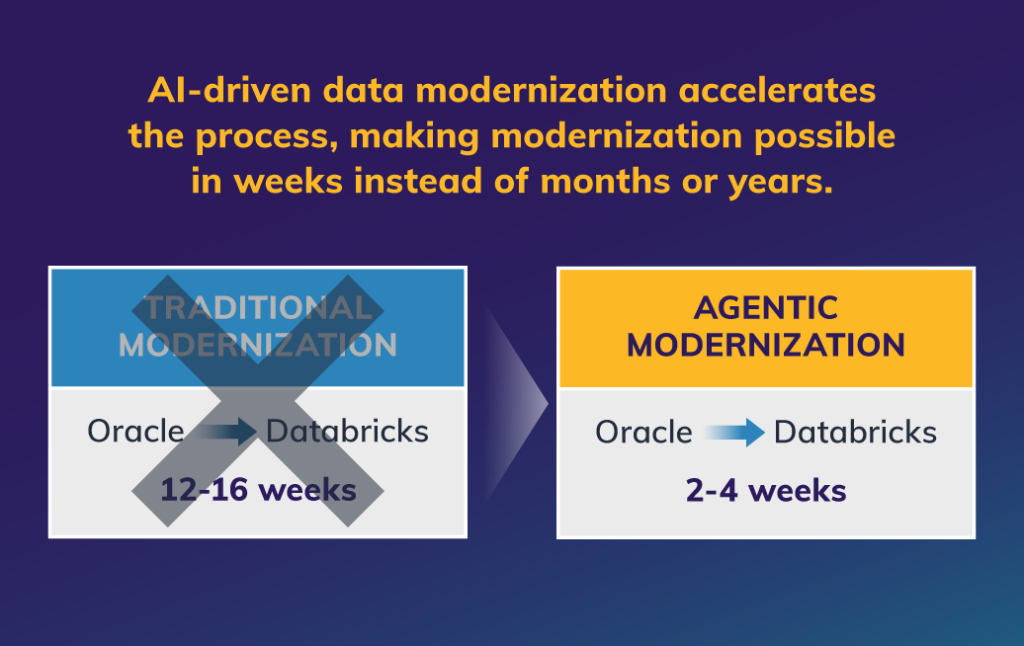
AI-driven data modernization accelerates the process, making modernization possible in weeks instead of months or years.
If you’re an IT leader who has worked through data migrations before, this PowerPoint slide is probably burned into your brain: The old Oracle environment is on the left side, and the new Fabric or Databricks environment is on the right. Between, an arrow points from left to right — and it’s been pointing that way for years.
Executives keep asking when you can get off Oracle, and the answer is always the same: “Soon.”
This dilemma is a structural problem inherent in the traditional modernization approach, which requires a lengthy inspection period while the old and new systems run side by side, costing time and money. But agentic AI can change the game for your organization.
AI agents can inspect what your legacy system does and generate a validated starting point for the new environment. This speeds up and de-risks the first phases of your legacy system modernization: migrate first, validate, then modernize in place.
In this blog post, we’ll cover how the parallel platform trap forms, why the traditional sequence is so expensive, how inverting it with agentic AI changes the math, and what it takes to make the AI-driven data migration approach work.
The multigeneration technology stack is a predictable outcome of the traditional migration approach. When every generation of tools requires a parallel operating period before the old layer can be safely retired, that period almost always extends past the arrival of the next generation.
Proving parity can take months or years, but there’s no way around it. You cannot cut over until you can prove the new environment produces the same outputs as the old one — and you cannot prove that without running both. That logic is sound from a risk management standpoint, but it’s also the mechanism that turns a two-year modernization program into a costly five-year one.
The business case for a modernization program typically includes two primary contributors:
However, it rarely captures the full cost of the parallel state, specifically the extended period between when the new environment starts and when the old one stops. That gap is where many programs become costly.
Three factors make the traditional modernization’s parallel state so expensive:
“Poor communication confuses employees about changes and their roles. Leaders must clearly communicate their vision and goals,” says Centric Consulting’s Chicago People and Change Consultant Michelle Swiatek. In contrast, effective communication “keeps employees informed about the reasons for change, the benefits, and the expected outcomes.”
Agentic AI does not eliminate these costs, but it changes when they show up and how long they last. When the parallel runway compresses from 18 months to six, the program economics change fundamentally.
Agentic AI makes a previously irrational step rational by doing the migration and parity work first, before modernization begins. This change in sequence collapses the parallel runway.
In the traditional approach, understanding what the legacy system does takes months of specialist work. You must:
But a well-designed AI-driven data migration approach compresses this process through a four-step sequence:
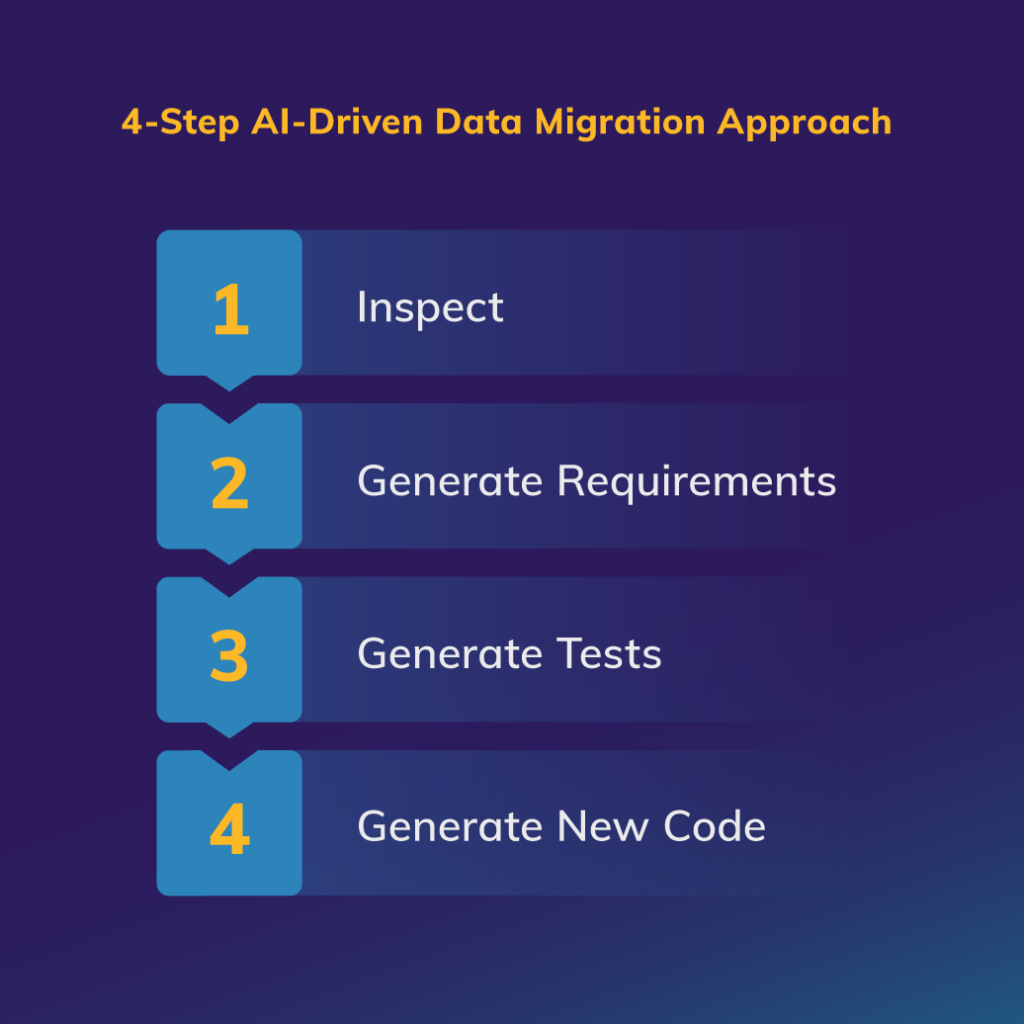
4-step AI-driven data migration approach.
Think of it as scaffolding: the temporary structure that lets you upgrade the building without disrupting the current occupants. The scaffolding isn’t the renovation. It’s what makes the renovation possible without maintaining a multiyear parallel state.
This new sequence provides a framework for agentic application modernization, but you’ll have work to do before it can run successfully.
The teams creating real results with an agentic approach apply the same discipline that made traditional data modernization trustworthy: acceptance criteria defined up-front, full parity testing, and human oversight at every phase transition. The only difference is AI-driven data modernization happens in a compressed timeframe.
Here are four requirements to make your zero-disruption migration sequence work:
Programs that are still evaluating one solution versus another when the inspect phase starts have to generate requirements against a moving target.
The inspect phase only delivers on its promise if you actually use the outputs as acceptance criteria. Organizations that generate requirements and treat them as suggestions reintroduce the ambiguity that slows down traditional migration.
Agents produce volume and speed that human teams can’t match. But they can also make errors that experienced data engineers catch right away. Every handoff needs domain review or a human in the loop.
The approval chains can create bottlenecks if they’re built for monthly review cycles, especially when agentic inspection produces actionable requirements within days.
The teams we have helped run this successfully have reported an interesting side effect: reduced risk. Since your time to parity shrinks, you know what works sooner so you can surface issues earlier. As a result, you have more time to address them.
The organizations stuck in the longest parallel platform states aren’t making bad decisions. They made the most rational choices available to them at the time.
However, the parallel runway that made traditional migration so expensive is no longer inevitable. AI-augmented development can make modernization projects feasible. If your program has been “90 percent done” for longer than you want to admit, you should ask whether the sequence was designed for a set of economics that no longer applies.
Our data and analytics team works on this problem with organizations at various stages of the parallel platform state. If that conversation is overdue — and maybe a little awkward — we welcome it.