Centric Consulting Ranks in Crain’s Chicago Business’s 100 Best Places to Work List
For the sixth consecutive year, Centric Consulting’s Chicago practice has been named among Crain’s Chicago Business’s 100 Best Places to Work.

Multi-agent frameworks promise to transform how you modernize legacy applications. But Gartner predicts that over 40 percent of agentic artificial intelligence (AI) projects will be canceled before they deliver value — casualties of escalating costs, unclear business value, and inadequate risk controls. The issue lies in choosing the wrong framework for the wrong problem.
In our experience leading enterprise modernization engagements, most agentic AI project failures trace back to architectural decisions made before a single agent was built. Five specific failure patterns, which we’ll use as evaluation criteria throughout this blog post, account for most of these cancellations. And every one of them is preventable with the right multi-agent framework decision.
Before we talk about multi-agent frameworks, let’s address what most information technology (IT) leaders reach for first: GitHub Copilot and Claude Code. These are the tools your teams already know, and for good reason.
GitHub Copilot offers deep integrated development environment (IDE) integration and fast inline suggestions across 20-plus languages. Claude Code brings exceptional reasoning on complex codebases, a million-token context window, and the ability to read, write, and refactor entire file structures autonomously.
Both are evolving rapidly.
As of early 2026, GitHub now offers Claude and OpenAI’s Codex as coding agents directly within the Copilot platform, and with Claude Code’s experimental Agent Teams feature, multiple Claude instances can work in parallel on different parts of a codebase.
So why not just use these tools to modernize your legacy systems?
There’s a fundamental difference between AI-assisted coding and AI-orchestrated modernization. GitHub Copilot and Claude Code excel at the coding layer: refactoring files, generating tests, explaining legacy logic, and translating between languages. But a legacy modernization project requires more than independent coding tasks. Legacy modernization involves a coordinated workflow that spans code discovery, requirements extraction, architecture redesign, development, testing, and validation. Each of those phases produces artifacts and context that the next phase depends on.
That coordination layer — deciding which agent works on what, managing shared context across phases, adapting behavior as the codebase reveals surprises, and controlling costs across dozens of parallel operations — is what a multi-agent framework provides. It’s the orchestration above the individual coding assistant.
With the coding assistant question settled, the real evaluation begins with the framework landscape.
There are plenty of multi-agent framework options to choose from. The challenge is knowing which one fits your modernization scenario. To choose well, you need to understand what goes wrong. Across dozens of agentic AI engagements, we’ve identified five architectural failure patterns:
These failure patterns give you a rubric for what to look for in the right multi-agent framework.
The question is structural: Do you adopt an off-the-shelf multi-agent framework, build a custom one from scratch, or take a hybrid approach that customizes on top of a purpose-built orchestration layer?
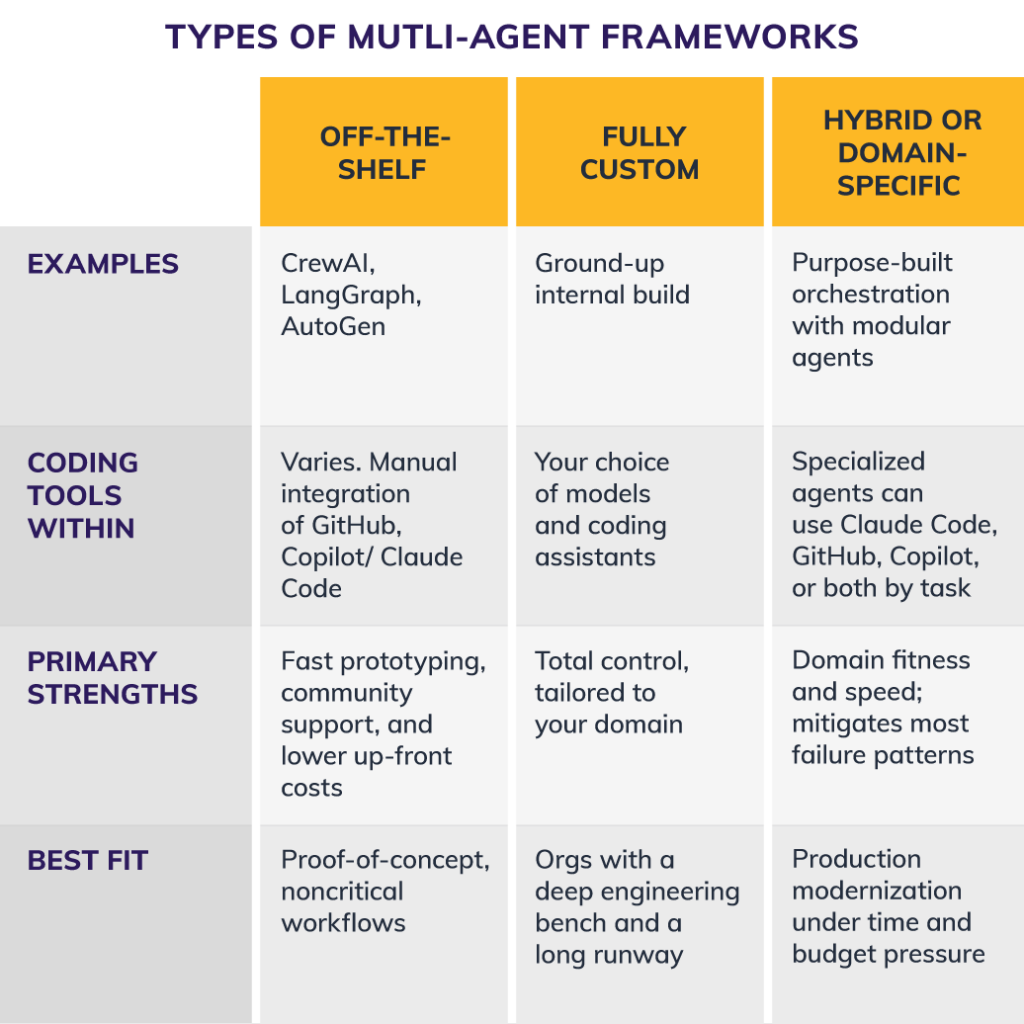
Comparing types of multi-agent frameworks: off-the-shelf, fully custom, and hybrid or domain-specific.
Off-the-shelf multi-agent frameworks get you building fast. But these tools were designed as general-purpose orchestration engines instead of the specific demands of legacy modernization. Notably, while you can wire a coding assistant into these frameworks, the integration work is manual, and the framework itself doesn’t know how to use those coding tools across a modernization workflow.
Fully custom multi-agent frameworks build offer maximum control, but they carry the heaviest risk of runaway costs. Building multi-agent orchestration, context management, cost controls, and governance from scratch is a significant undertaking. In our experience, most organizations underestimate the timeline by a factor of two or more. Unless you have a deep engineering bench and a long runway, a ground-up build creates the very technical debt you’re trying to eliminate.
Hybrid approaches are purpose-built orchestration layers with modular, swappable agents that mitigate the most failure patterns when the orchestration layer is designed for your domain. These architectures can assign different AI models and coding tools to different agents based on the task. The key differentiator is whether the framework adapts to your business processes rather than forcing you to adapt to it.
Now that you’ve got an idea of what type of multiagent framework would work best for your organization, here’s how to further narrow down your choice.
When evaluating any multi-agent framework for legacy modernization, apply these five tests:
If the framework routes everything through a single agent, you’re building a do-everything agent that will collapse under complexity. Individual coding assistants are powerful, but modernization requires distributing discrete responsibilities across specialized agents with clear boundaries.
Legacy codebases surface surprises constantly, like undocumented business logic, shifting code patterns, and emerging dependencies. Your framework needs agents that adjust their approach as context evolves, not agents that break when conditions deviate from the original prompt.
Agents need the right information at the right time, not a firehose of every prior interaction. This is where individual coding tools hit their limits: Claude Code’s million-token context window is formidable, but when 22 agents are working in parallel across a complex codebase, what each agent sees needs to be scoped, sequenced, and curated by the framework.
This separates genuinely flexible architectures from those that impose their own workflow assumptions. For legacy modernization, where every codebase has unique characteristics, framework rigidity is a project killer.
A single GitHub Copilot session is predictable. Dozens of agents making parallel application programming interface (API) calls across multiple models is not possible unless the framework provides granular visibility into what each agent is consuming.
Choosing the right multi-agent framework matters, but how much does it actually change the outcome? Let’s look at the numbers.
In a recent legacy modernization engagement, a single senior architect working with 22 specialized AI agents delivered 100 percent feature parity and 86 percent automated test coverage in two weeks. The traditional estimate for the same scope: 16 weeks with a five-person team. That’s an 86 percent compression in time-to-production, and the resource math is just as stark.
The traditional approach required five full-time engineers with deep knowledge of the legacy codebase. The agent-augmented approach required one architect who understood the business domain and could direct specialized agents through code discovery, requirements extraction, redesign, development, and testing.
These results align with broader patterns across engagements: 30–50 percent cost savings, 30–80 percent faster timelines, and 10–20 times the productivity gains per resource.
But I want to be precise about what these numbers represent. They are ranges, not guarantees. They depend on framework fitness, codebase complexity, and organizational readiness, which is exactly why the framework decision matters so much.
The mark of genuine expertise is knowing what not to build. Here are the conditions where I’d steer a client away from a multi-agent modernization approach, even if they’re already sold on the technology.
If you’re modernizing a 10,000-line application with clear documentation and active developers who understand it, the overhead of standing up a multi-agent framework isn’t justified.
When every line of code needs to be traced to a specific requirement with full audit provenance, agents introduce a validation burden that can exceed the productivity gains. This applies particularly in safety-critical systems where the cost of an undetected error is catastrophic.
If your organization doesn’t have the governance structure to validate AI-generated outputs systematically, you’re not ready for agent-augmented development at scale. Deploying agents without the governance to match creates risk that’s even harder to unwind than the technical debt you’re trying to eliminate.
AI agents are remarkably capable at code discovery and pattern recognition, but they’re not magic. If the legacy system has zero documentation, no test suites, departed developers, and convoluted architecture, agents will struggle just as much as humans would, but faster and with more confidence. That’s a dangerous combination.
In each of these cases, the most valuable move is better preparation. Agents amplify what’s already there, which means the quality of your foundation determines the quality of your results.
The sweet spot for agent-augmented modernization is in large, complex codebases where the original developers have departed, business logic is embedded but undocumented, technical debt has accumulated over years, and there’s pressure to modernize fast.
The multi-agent framework you choose today determines whether your modernization project joins the 40 percent that Gartner predicts will be canceled, or the cohort that delivers production results in weeks, not quarters.
Donavan Stanley, senior architect of AI agents and LLMs at Centric Consulting, said, “Speed without verification is a liability. Sometimes the right answer is to invest in governance and documentation first, then revisit modernization with agents once the foundation supports it.”
Our AI agent development experts know how to identify the right multi-agent framework for your modernization challenge and how to build for production, not just proof of concept. Learn more.