
Consulting Magazine Names Danielle Maldonado a Diversity Champion in 2026 Women Leaders in Consulting Awards
Centric’s Danielle Maldonado named a Diversity Champion in Consulting Magazine’s 2026 Women Leaders in Consulting awards.

Operations, technology, and business leaders who are pressured to adopt AI and aren’t sure they’re choosing the right solution for the right reasons.
Business leaders are under pressure to adopt AI. Boards are asking about it. Competitors are announcing it. And somewhere between the mandate and the road map, most organizations make the same mistake: They pick a tool, then look for a problem to attach it to.
That’s why so many AI initiatives stall. According to MIT, 95 percent of generative AI pilots are failing to deliver measurable business impact. Companies seeing real results share one trait: They pick a specific pain point, execute against it, and build from there.
The technology usually is not the problem. The approach is.
And in many cases, that approach starts even earlier than execution. Organizations are deploying the wrong type of AI entirely. Companies think the question is agentic AI versus generative AI versus traditional automation, but these solutions all perform fundamentally different kinds of work.
That’s why starting with the solution and working backward backfires. When a company reaches for generative AI because it is visible and well-funded rather than because the problem actually calls for it, failure is baked in before a single line of code is written.
Part of what makes this hard is that the landscape is genuinely confusing. Chatbots, copilots, AI agents, automation, generative AI. These terms get used interchangeably in board decks and vendor pitches, even though they describe fundamentally different capabilities designed for different types of work.
Here’s how to work forward from your business problem to find the solution that fits.
Companies succeeding at AI initiatives have something in common: They start with a specific problem, then find the tool to solve that problem.
Most organizations do the opposite. They pick an AI solution, then look for a problem to solve with it.
We see this consistently in our work with clients. A board mandate, a competitor announcement, or a vendor pitch creates urgency, and that urgency narrows focus to a single tool. In their rush, companies don’t look at what the work actually requires and skip the most important step: defining what the process needs before deciding how to address it.
That narrowed focus creates a predictable pattern. The team selects a tool, builds around it, and later discovers the solution does not fit the work. At that point, your organization has wasted time and money on an ineffective solution, and you must start from scratch while convincing doubtful stakeholders that this time, your solution will actually work.
It helps to start with a shared vocabulary. Here’s a quick refresher on agentic AI versus generative AI versus traditional automation:
If you use the wrong solution, you’re wasting money and creating a governance risk and team frustration. The AI initiative gets blamed for underdelivering when the real issue was a mismatch from the start.
The right AI solution isn’t the most sophisticated one. It’s the one that fits the problem. These four questions help you identify the problem so you can choose the right tool.
If a human needs to approve every step or the process follows a sequence with predictable inputs, the work does not require an agent. AI agents make sense when the work spans multiple systems, involves variable inputs, and requires decisions to be made without waiting for human direction at each step. When the inverse is true, simpler tools will outperform every time.
This is often the clearest diagnostic. If your process follows the same steps every time with predictable inputs and outputs, deterministic tools like robotic process automation (RPA) are the right fit.
Nick Rahn, an architect in Centric Consulting’s National Operational Excellence Practice, says: “Many of our longer-term engagements have nothing to do with AI as we see it today. The work is deterministic, so we want to control the outputs, the inputs, and where data is flowing. RPA handles that reliably.”
If your inputs vary —for example, unstructured invoices, vendor emails, documents your systems cannot easily parse — then agents might be a better fit than traditional automation.
Before deploying something that operates without continuous human oversight, you need to know what bad output costs.
Shiva Varma, senior director analyst at Gartner, put it plainly in May 2026: “Enterprises are treating AI agent governance as binary, either locked down or fully trusted, and that is the root cause of failure.”
Gartner predicts that up to 40 percent of enterprises will demote or remove autonomous AI agents for business uses by 2027, thanks to governance gaps revealed after product incidents. In heavily regulated environments or processes requiring deterministic output, AI governance and foundational data work should come first.
Assess your data environment honestly. Informatica’s 2025 CDO Insights survey found that 43 percent of data leaders cite data quality as the leading obstacle to moving AI pilots into production.
If your team cannot answer this before the technology decision is made, the technology decision is premature. RAND Corporation learned that leadership’s misunderstanding of what problem needs to be solved is the most common cause of AI project failure, cited by 84 percent of practitioners interviewed.
“You need to critically evaluate what you need, where you are deploying it, and what benefit you want from it. You need to measure that productivity and ensure you are getting that value as you make the investment,” said Joseph Ours, director of AI strategy at Centric Consulting, in a Harvard Business Review report.
Answering these questions honestly will point you toward a solution category before you ever evaluate a specific tool.
Not every problem needs the most powerful tool available. In fact, jumping to the most powerful and complex tool often leads to AI pilots failing. The simplest solution that solves the problem is almost always the right one.
AI agents add capability but also complexity, governance overhead, and cost. Often, a simpler solution — like RPA, generative AI, or traditional automation — can solve your problem.
Use these rules of thumb as a starting point:
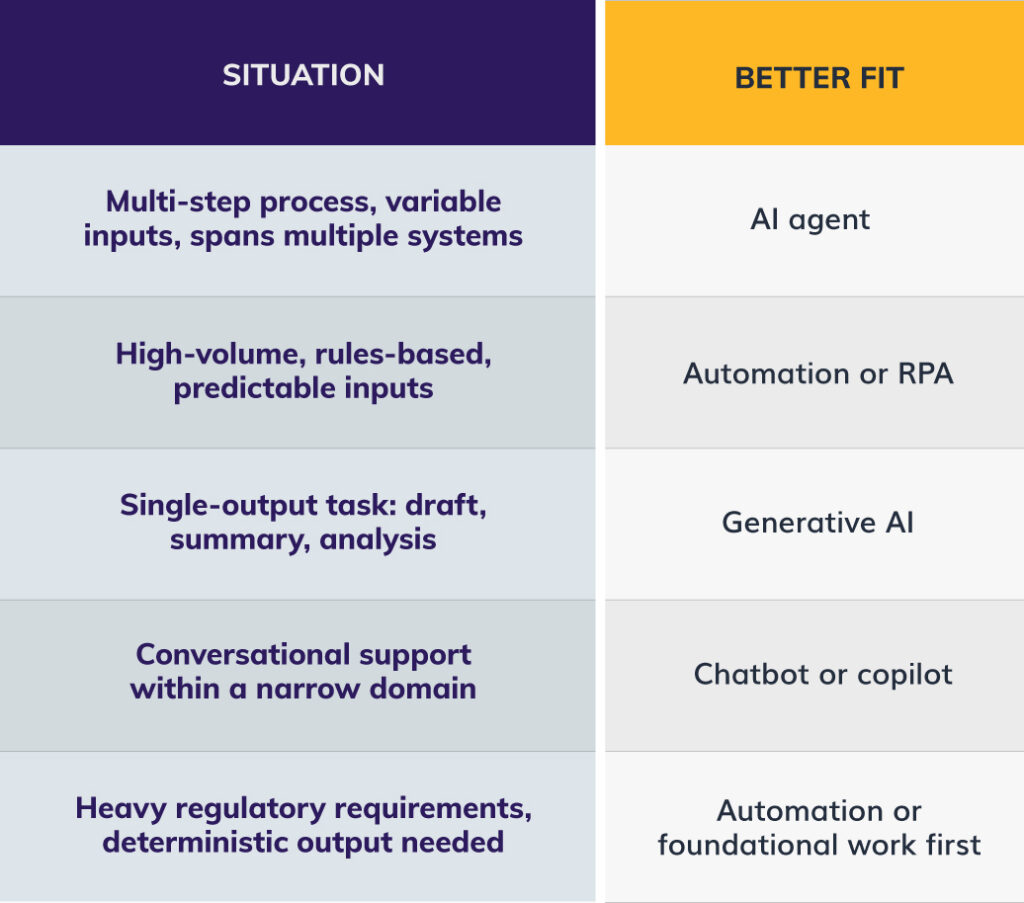
A side-by-side comparison highlights which AI approach—agentic AI, automation, generative AI, or chatbots—is best suited for different business scenarios.
Remember: Most problems do not require the most sophisticated tool. They only require the right one.
Two patterns come up repeatedly in our work with clients:
Both mismatches share the same root cause: The technology decision came before the problem definition.
The business problems that organizations bring to us have not fundamentally changed. The tool they’re convinced they need has.
The work of untangling this distinction starts with slowing down long enough to define what solution actually solves the problem.
The technology conversation is easier when the problem conversation comes first.
In our AI consulting work, we start every engagement with the business outcome: what needs to change, how you will know it changed, and what your organization is actually ready to support. From there, we assess a range of factors, such as governance maturity, data quality, and infrastructure, before recommending a solution category, let alone a specific tool.
When we do recommend a solution, we recommend the simplest one that solves the problem. And before anyone builds at scale, we pilot. That is not a slow approach. It is the approach most likely to produce something that works, gets adopted, and holds up over time.
If you aren’t sure whether your organization needs agentic AI versus generative AI versus automation, or something simpler, that uncertainty is worth exploring before you build anything.
Our AI consulting team can work through it with you. Let’s talk.
AI agents handle multistep processes that require autonomous judgment across multiple systems. Generative AI produces a single output from a prompt, such as a draft, summary, or analysis. Traditional automation executes rules-based processes that are predictable, repeatable, and do not require judgment. The right choice depends on the nature of the work, not the sophistication of the tool.
A problem is a good fit for an agent when it involves variable inputs, spans multiple systems, and requires decisions to be made without human direction at each step. If the process is rules-based and the outputs are predictable, traditional automation is likely the better fit and will be easier to implement, govern, and maintain.
Most AI initiative failures are not technology failures. They are strategy failures. An MIT study published in August 2025 found that 95 percent of generative AI pilots are failing to deliver measurable business impact. The most common root cause is choosing a solution before fully defining the problem, which leads to mismatched tools, poor adoption, and initiatives that cannot demonstrate ROI.
Before deploying an AI agent that operates without continuous human oversight, organizations need accountability for agent behavior, defined escalation paths, and a data environment that is secure and well-governed. Gartner predicts that by 2027, 40 percent of enterprises will demote or decommission autonomous AI agents due to governance gaps identified only after production incidents. In regulated environments, governance and foundational data work should come before deployment.
Start by defining the specific metric you are trying to move before you build anything. That could be cycle time, error rate, cost per transaction, or response time. Establish a baseline, set a target, and measure against it after deployment. If you cannot define what success looks like before the project starts, the technology decision is premature.