
AI Agents Aren’t Creating Security Problems. They’re Revealing Them.
AI agents don't create new cybersecurity threats, they expose years of unmanaged access and weak governance. Learn why closing this security gap starts with AI governance.

This blog is for leaders who are under pressure to deliver faster, make better decisions, and get more value from AI without adding more complexity to already busy teams. Whether you lead a PMO, transformation office, business function or delivery team, the challenge is the same: figuring out how people and AI agents can work together in a practical, trusted way.
For many leaders, the question is no longer whether their teams will use AI — it’s whether AI will improve delivery, decision-making, and results.
Right now, many companies aren’t getting AI right. Digital Applied’s research found 88 percent of AI agent pilots fail to go into production. In another study, a Project Management Institute survey showed that 60 percent of respondents gave their companies a four out of 10 for AI maturity.
The risk of a failed AI project is larger than wasted investment. That risk includes lost momentum, lower stakeholder confidence, and another initiative that fails to show clear business value.
The secret to success isn’t simply adding AI tools to workflows. It’s redesigning those workflows. The Digital Applied report also found that high performers are three times more likely to have redesigned workflows as part of their AI efforts.
Winning programs don’t simply use AI more. Instead, they use AI orchestration to build a brand-new delivery model by weaving agentic AI into core processes. Gartner predicts that 40 percent of enterprises will have embedded task-specific AI agents by the end of 2026. That figure was only 5 percent in 2025.
But as the use of AI agents grows, many organizations continue to struggle. Their mistake is asking “Where can we use AI?” and then adding AI tools without taking the time to evaluate the workflow in the first place.
Instead, you should ask “Where can AI remove friction, so people have more time for the work that requires context, judgment, and relationships?”
There’s a meaningful difference between a program that has AI and a program that runs with AI, and that difference shows up most clearly under pressure.
In a program delivery context, agent orchestration means making multiple specialized agents work in parallel, handing off to one another. At the same time, humans own the decisions that require judgment or accountability.
It’s equally important to note that AI orchestration is not about designing a single “super AI” that does everything. Rather, you set up a series of agents that work together like a team.
As Centric Consulting’s Director of AI Strategy Joseph Ours points out in our post “How AI Agents Are Reshaping Project Management,” each agent takes on a specific role: “These intelligent agents can be custom designed to automate tasks, analyze datasets, and deliver real-time insights.”
The easiest way to illustrate how orchestration works is to think of each agent as a teammate with a specific skill.
For instance, in a hospital, you have a triage nurse, an emergency room doctor, an X-ray technician, and a radiologist. If a patient comes in with a broken bone, each teammate does what they’re good at:
The patient gets “handed off” to each “agent,” just like a task or project gets handed off to different AI agents during orchestration. Let’s consider how long each of these “agents” takes to do their work:
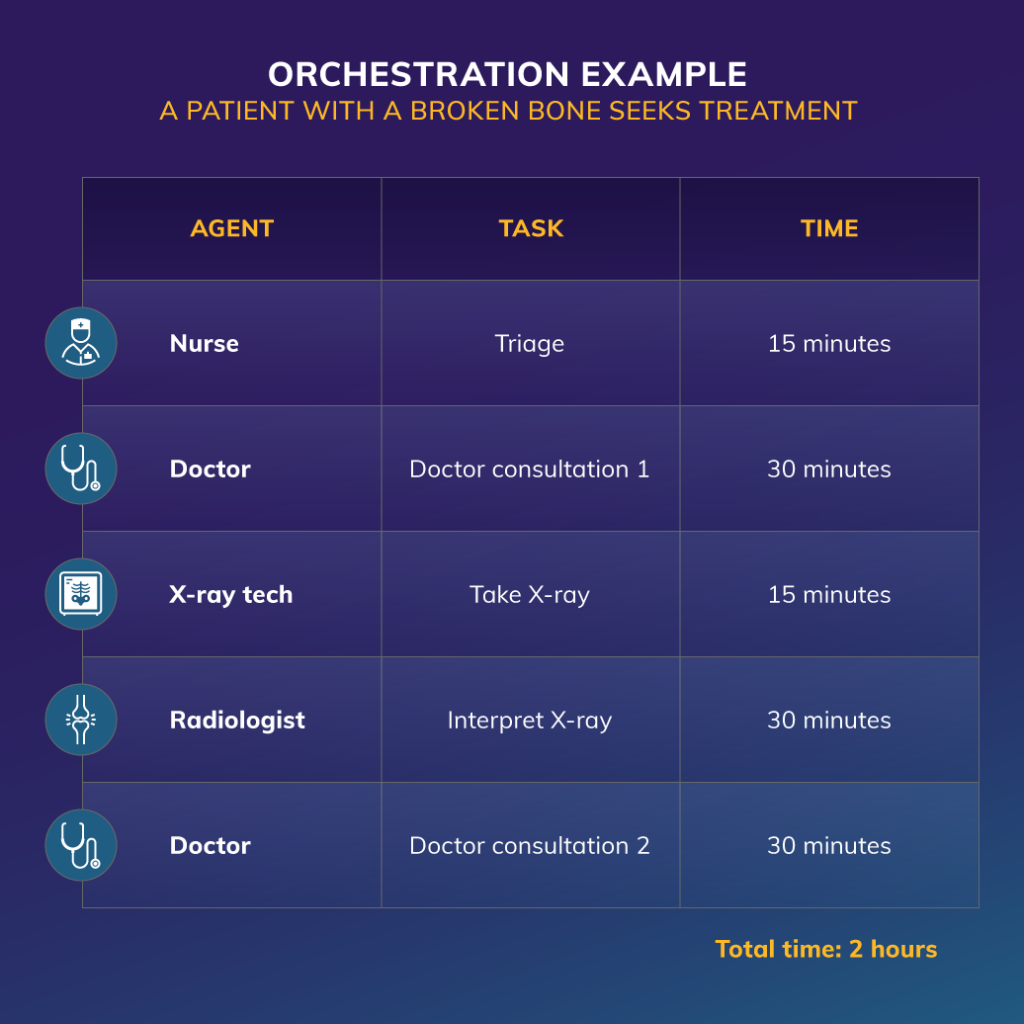
An example of orchestration in the emergency room when a patient with a broken bone comes in for treatment. The total process takes 2 hours.
Now, suppose you try to improve the system by giving the doctor AI-guided triage software and an X-ray machine. With one person (the doctor) now doing the work of four people, will the process take less time?
Probably not, because the doctor is not skilled at gathering triage information the software program might miss, and she isn’t trained to run an X-ray machine or read the results as a radiologist would. She would take more time by asking others for help, taking time from their workflows.
Plus, the hospital would fail at its most important metric: improving patient care.
In the same way, successful AI orchestration isn’t about giving team members AI tools. Orchestration is successful when you design specialized AI agents to handle mission-critical tasks.
In his article about the failures that hold back AI agents, Centric CEO Larry English stresses this consideration: The most pivotal decision when building an agent-supported program is where to implement human oversight.
“Agents will fill every gap in instructions with their own judgment, and that judgment isn’t always what you’d expect,” English says. “Before deployment, conduct edge case exercises with the goal of generating AI agent guardrails and instructions for telling agents what not to do, what paths are off-limits, and what scenarios require escalation to a human.”
When you get the orchestration and human involvement right, even modest, simple agents can shave precious minutes and hours off delivery timelines.
Here’s how to nail your AI agent handoff strategy:
A good example of integrating handoffs to improve efficiency is to build a weekly status report. Without AI agents, a human would have to manually collect, analyze, and present several kinds of data from disparate sources. But with AI agents, AI can draw the necessary data from specific processes.
When you need a human to interpret the data, that task is handed off to a person. They may adjust the wording of a productivity analysis, for instance, so that it more accurately reflects team members’ performance.
At Centric, our enterprise project portfolio management (EPPM) point of view is simple: The future of delivery will include both human and digital workers operating in a new way of working.
People should stay focused on the work that requires heart and head — building trust, leading teams, making judgment calls, setting priorities, and guiding change — while agents help with the hands-on work, such as gathering data, preparing drafts, monitoring signals, summarizing meetings, and surfacing insights.
When people and agents work together intentionally, teams can move faster, improve quality, and make decisions with better information. This is not about replacing the human role in delivery. The goal is to give leaders and teams more capacity for the work clients value most: managing stakeholders, coaching teams, navigating complexity, and driving outcomes.
We’ve carried this point of view into our work on enterprise transformation, where we’ve delivered resource-saving programs in high-stakes situations with multiple workstreams. One client had hundreds of interconnected tasks across multiple teams. The solution also had to accommodate more than 30 vendors and 24/7 operations.
We introduced AI agents as controlled delivery accelerators by building AI agents that:
The value came from giving each agent a narrow, accountable role and designing human handoffs around risk, escalation, and decision quality. Teams spent less time gathering and formatting information and more time acting on it.
The mistake most programs make is trying to introduce AI during execution, but by building orchestration from the start, you ingrain it into your workflows’ DNA. Follow these steps to embed orchestrations into your workflows:
A meaningful project and a modest system with easily measurable outcomes will help you achieve some quick wins and practice redesigning a workflow. After deployment, you’ll learn the best kinds of data to feed your agents to produce consistently excellent outputs.
Limit the scope of agent tasks to a few simple things that will save time or resources.
AI agent governance should define what agents can do, what they should never do without human review, and when they must pause to ask a clarifying question instead of assuming an answer.
Human oversight of AI outputs, particularly before you hand a process over to another agent, prevents outcomes that don’t align with your objectives.
Start by selecting one workflow where the business value is visible, the data sources are known, and the human decision points can be clearly defined.
Then, take your learnings and build another agent-powered process. Scale up gradually until you’ve met your efficiency objectives.
The organizations seeing the greatest impact from AI agents use them to redesign how work gets done. Like a team of medical professionals, your AI agents should each have specialized skills and work together. Even an agent with a limited capability can shave precious minutes off important tasks.
Start small with one high-value workflow, prove the impact, and use AI agent oversight and governance to keep outcomes aligned with your goals. With that disciplined approach, organizations can move from isolated AI experimentation to a scalable delivery model where human and digital workers coexist, each doing the work they are best suited to do.
Our AI strategy and EPPM experts can guide you through the entire process, from planning to implementation.