
We share why your CIO and PMO relationship is vital to your business, and how working together strengthens your business strategies.
Your Information Technology (IT) department is the backbone of your organization. With broad responsibility for architecture, data, hardware, software and networking company-wide, creating a solid foundation is essential to your overall success. And as departmental responsibilities have grown to encompass not only a greater number of projects but also more complex projects, we cannot understate the value of the relationship between your Chief Information Officer (CIO) and Project Management Office (PMO).
The PMO defines and maintains project management best practices across an organization, ensuring employees adhere to status, progress and strategy throughout a project’s life cycle.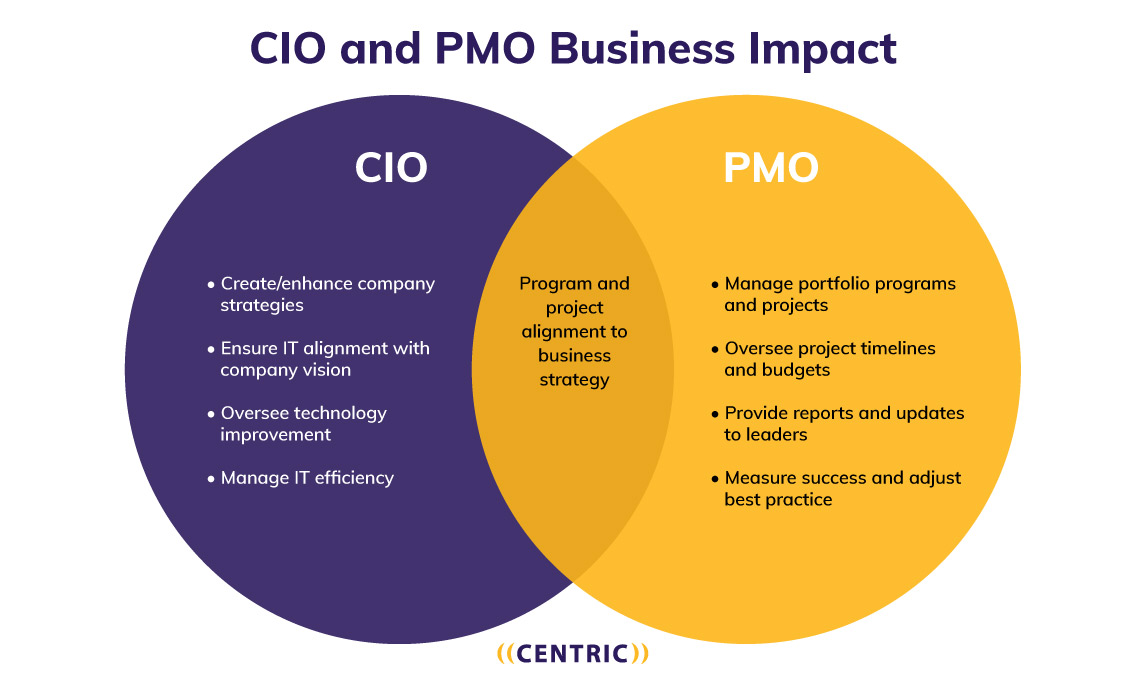 At the same time, the CIO works to ensure the best use of internal and external technologies and promotes continuous business efficiency improvement.
Because your PMO has direct insight into the time and effort of every task within the key projects, cultivating a strong relationship with your CIO not only gives them additional visibility into opportunities for improvement in the business processes, but it also allows improvement within IT to support the business and leads to more successful projects.
According to the Project Management Institute’s Pulse of the Profession 2020 report, organizations that undervalue project management as a strategic competency for driving change report an average of 67 percent more of their projects failing outright.
Regardless of your company’s PMO size or maturity or how you draw the reporting lines, the CIO needs to value and maintain a strong relationship with the PMO.
At the same time, the CIO works to ensure the best use of internal and external technologies and promotes continuous business efficiency improvement.
Because your PMO has direct insight into the time and effort of every task within the key projects, cultivating a strong relationship with your CIO not only gives them additional visibility into opportunities for improvement in the business processes, but it also allows improvement within IT to support the business and leads to more successful projects.
According to the Project Management Institute’s Pulse of the Profession 2020 report, organizations that undervalue project management as a strategic competency for driving change report an average of 67 percent more of their projects failing outright.
Regardless of your company’s PMO size or maturity or how you draw the reporting lines, the CIO needs to value and maintain a strong relationship with the PMO.
Understanding Responsibilities Between the CIO and PMO
Your CIO and PMO share responsibility for achieving your organization’s strategic goals and outcomes. While day-to-day activities vary, a CIO is ultimately responsible for optimizing productivity to improve and grow the business through IT oversight. To achieve this, the CIO must focus on aligning programs and projects in support of delivering the company’s strategies and goals. This is where the PMO can put their skills to use. Your PMO and Enterprise PMO (EPMO) responsibilities include more granular objectives that support your CIO, from collaborating with company leadership to prioritizing and managing the portfolio of programs and projects and ensuring they align with and support overall strategic goals. A successful PMO:- Aids in idea qualification to determine measurable business value.
- Determines, in concert with the CIO, if the company has the technology, skills, tools and resources to support the idea or business case concept.
- Collaborates with business leaders and the CIO to understand, define, and prioritize business cases for all programs and projects.
- Plans timing and execution of project schedules, executing under the project management triangle of time, cost and scope. This gives the CIO insight into opportunities to improve in all areas affecting the process, capacity and priorities.
- Shows business benefit realization using agreed-upon metrics.
Aligning Business Outcomes to Meet Company Needs
Company growth and realizing a return on your investment require high-quality and timely execution of projects and programs. According to the 2020 Pulse of the Profession report, companies waste 11.4 percent of investments due to poor project performance. Because technology and IT provide the underpinning and enablement of almost every project initiative, aligning business outcomes between your CIO and PMO is essential. If your company is a project-based company, executing projects for your customers, the relationship between your CIO and PMO is even more critical. The PMO will continuously work to improve project standardization and productivity as they execute projects while also aiming to reduce costs and improve delivery. Suppose your company is an agile product-based company, using a more flexible project management methodology. In that case, your PMO focuses on value-driven business outcomes. They work in concert with your CIO to be a consultative, participative leader who guides the prioritization of outcome and value-based work.Effective CIO and PMO Communication Facilitates Growth
To ensure growth, your company’s PMO must constantly communicate with your company’s leadership and CIO, providing accurate and timely communication regarding project status, from people updates to budget, timeline and results. Effective communication leads to:- Proactive identification and mitigation of risks and impediments
- Transparency in terms of support, funds and time needed to keep a project on track and budget
- The successful management of the flow of information, which results in better outcomes.