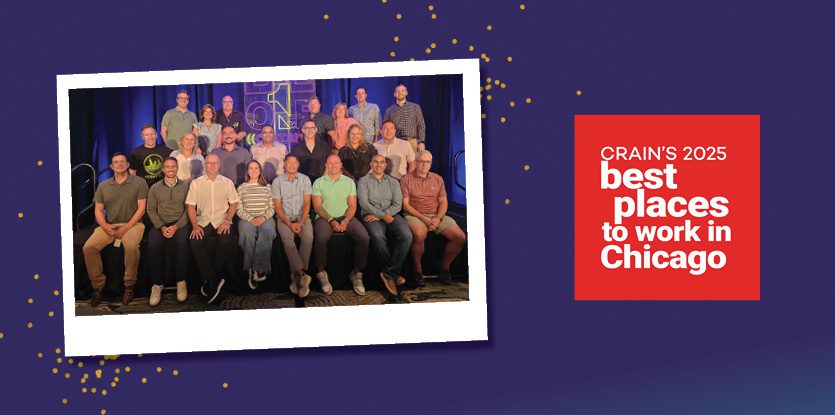
Centric Consulting Ranks in Crain’s Chicago Business’s 100 Best Places to Work List
For the sixth consecutive year, Centric Consulting’s Chicago practice has been named among Crain’s Chicago Business’s 100 Best Places to Work.

Large language models (LLMs) are revolutionizing business operations and offering unprecedented capabilities in natural language processing, problem-solving, and task automation. As the market evolves, four options have emerged at the forefront of business use cases: ChatGPT, Claude, Gemini, and open-source models.
Each brings unique strengths to the table, catering to different needs in the AI ecosystem. As organizational leaders evaluate their operational needs, readiness for agentic workflows, and potential ROI from these sophisticated tools, understanding the nuances between seemingly identical tools is critical for making an informed decision.
As a business and technology consulting firm, my company embraces AI technologies. In addition to using these tools, we use firsthand experience to guide clients as they implement AI solutions that can drive value in their organizations.
Developed by OpenAI, ChatGPT has become synonymous with conversational AI. Its models offer advanced reasoning capabilities and an internal chain of thought that significantly enhances its output quality. This makes ChatGPT particularly valuable for businesses as they think through their business strategy.
ChatGPT’s strength lies in its versatility and continuous improvement in logic and reasoning. Key features of ChatGPT include:
Looking ahead, OpenAI’s models, including ChatGPT, remain central to Microsoft Copilot, which gives OpenAI a formidable presence in both consumer and business markets, even as Microsoft adds other model options.
Anthropic’s Claude distinguishes itself through its emphasis on ethical AI and deep analytical capabilities. Since its launch in March 2023, Claude has built a strong following for its reasoning skills and focus on safety through constitutional AI.
This approach features built-in safeguards for ethical behavior based on human values.
Claude’s standout features include:
Claude excels in industries where ethical considerations are nonnegotiable, like the healthcare, finance, and legal sectors. Its natural writing style is well suited for standard business communications, and Claude’s ability to handle complex programming tasks often surpasses that of ChatGPT, making it a favorite among developers.
In the last two years, Claude has also made strides toward reaching business users inside the tools they already use. It’s available in Microsoft 365 Copilot and offers its own integrations with Asana, Excel, PowerPoint, Word, and many other tools, so adopting it doesn’t require moving your team to a new platform. However, that availability can vary. In Microsoft 365 Copilot, for example, access to Claude depends on your region and admin settings, so confirm what’s available in your environment before you plan around it.
Google’s Gemini sets itself apart with its multimodal capabilities, giving users a Copilot-like experience in Google Workspace. Designed to understand and operate across various types of information, Gemini offers a unique proposition for businesses deeply embedded in the Google ecosystem.
Gemini’s key attributes include:
Because Gemini now comes bundled with paid Google Workspace plans, it’s a natural starting point for organizations already using Google’s tools. While that same focus may limit Gemini’s market penetration in non-Google environments, it positions the tool for near-total capture within its niche.
For organizations skeptical of commercial LLMs or that require airgap solutions (i.e., solutions isolated from unsecured networks), open-source models provide a different path. Simply download the model and run it on your own infrastructure so your data never leaves your environment.
Key advantages of open-source models include:
These models offer flexibility and customization options that commercial models can’t match — while also offering maximum security for industries with stringent data security requirements or those looking to build highly customized AI solutions. Examples include defense and military, government agencies, financial institutions, critical infrastructure, and research facilities with confidential data.
The trade-off is complexity. Your team takes on the hosting, security, and turning that a commercial provider would otherwise handle, and open-source models may not match the leading commercial models on the most complex reasoning tasks.
LLMs are transforming how businesses operate across industries, including manufacturing, healthcare, finance, and insurance. Use cases include tasks like content and marketing strategy, customer service and support, research and analysis, software development support, employee training, operations process documentation, sales support, and more.
As these models continue to develop, we expect to see further specialization and enhancement of their strengths. Business leaders will need to carefully consider their specific needs, existing technology ecosystems, and long-term AI strategies when choosing which LLM to invest in or adopt.
The LLM your organization chooses will be based on several considerations, including: whether you require creative solutions, data-driven insights, an integrated solution, or a standalone one, as well as what your scalability requirements look like and your employees’ appetite for adopting new tools.
The future of AI in business is not about finding a one-size-fits-all solution, but leveraging the right tool or combination of tools to drive innovation, efficiency, and growth in a world increasingly powered by AI solutions.
This article was modified for 2026, but the original can be found on Forbes.com.